The Tyrant’s Dialogue
A philosophical thriller told in the form of a Platonic dialogue.
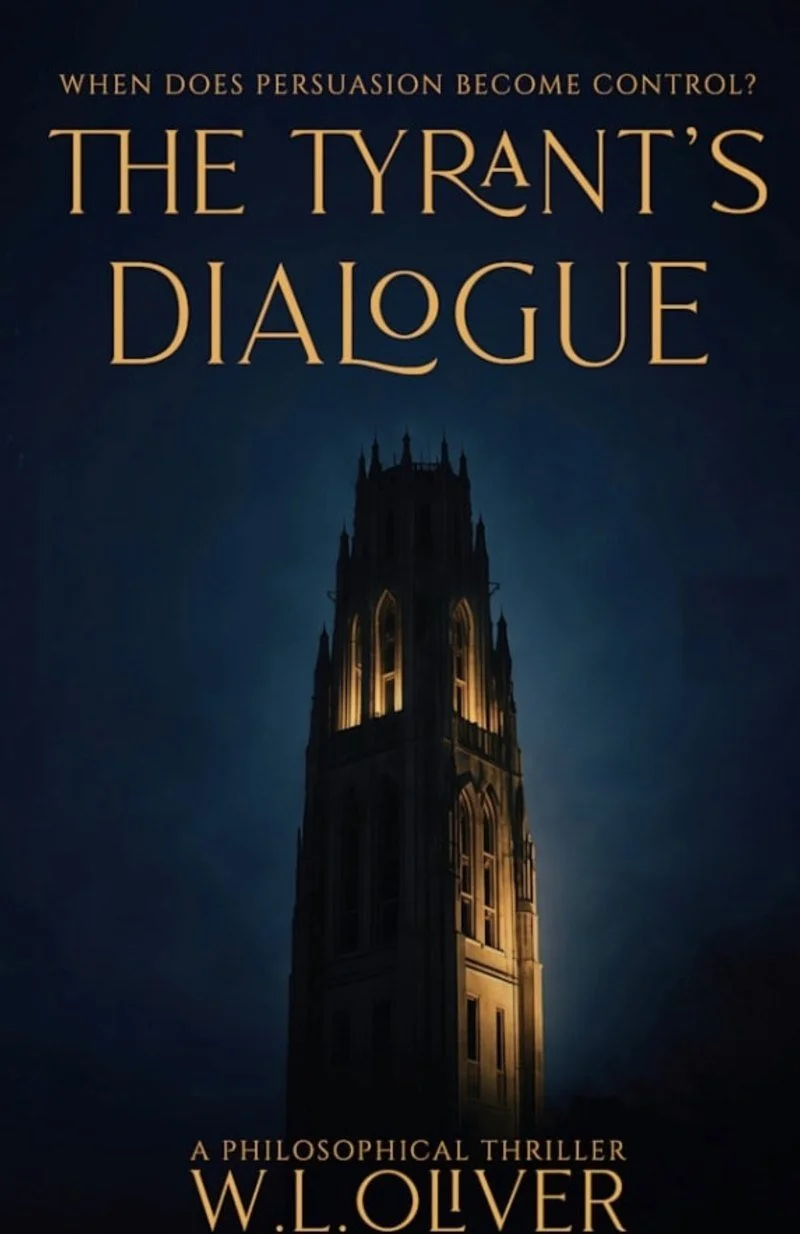
Dartmouth “Dart” Marlowe has spent his life reading people. First as an officer in British naval intelligence, and now as a professor of classics at Yale, where the arguments are older but no less dangerous.
Dr. Elias Varro taught him much of what he knows. Today Varro is one of the most celebrated minds in the world, and he is making a case that is winning converts in lecture halls, boardrooms and corridors of power: that freedom is an illusion, and that civilization endures only when it is guided by an enlightened few.
Varro’s argument is elegant. It is persuasive. And Marlowe knows exactly where it leads.
Drawn into a public confrontation with the man who shaped him, Marlowe follows the thread from New Haven to Cambridge, Athens and Venice. Every step brings him closer to a final reckoning at the Metropolitan Museum of Art, where an ancient Egyptian temple stands witness to an argument that will decide whether honest doubt can stand against the seduction of certainty.
Five Cities. One Argument.
New Haven
41.31° N · 72.92° WYale, where a classics professor discovers that an old argument has found a dangerous new voice.
Cambridge
52.20° N · 0.12° EAncient colleges, where arguments have been weighed for eight centuries.
Athens
37.98° N · 23.73° EThe city where the dialogue was born, and where the questions are oldest.
Venice
45.44° N · 12.33° EA republic of mirrors, where power always wore a mask.
New York
40.78° N · 73.96° WThe Temple of Dendur at the Metropolitan Museum of Art. The final reckoning.
The danger was never the tyrant.
It was how reasonable he sounded.
Buy the Book
Bookstores and libraries can order through Ingram.
For readers of Umberto Eco, Donna Tartt, Robert Harris, Dan Brown and Pascal Mercier